
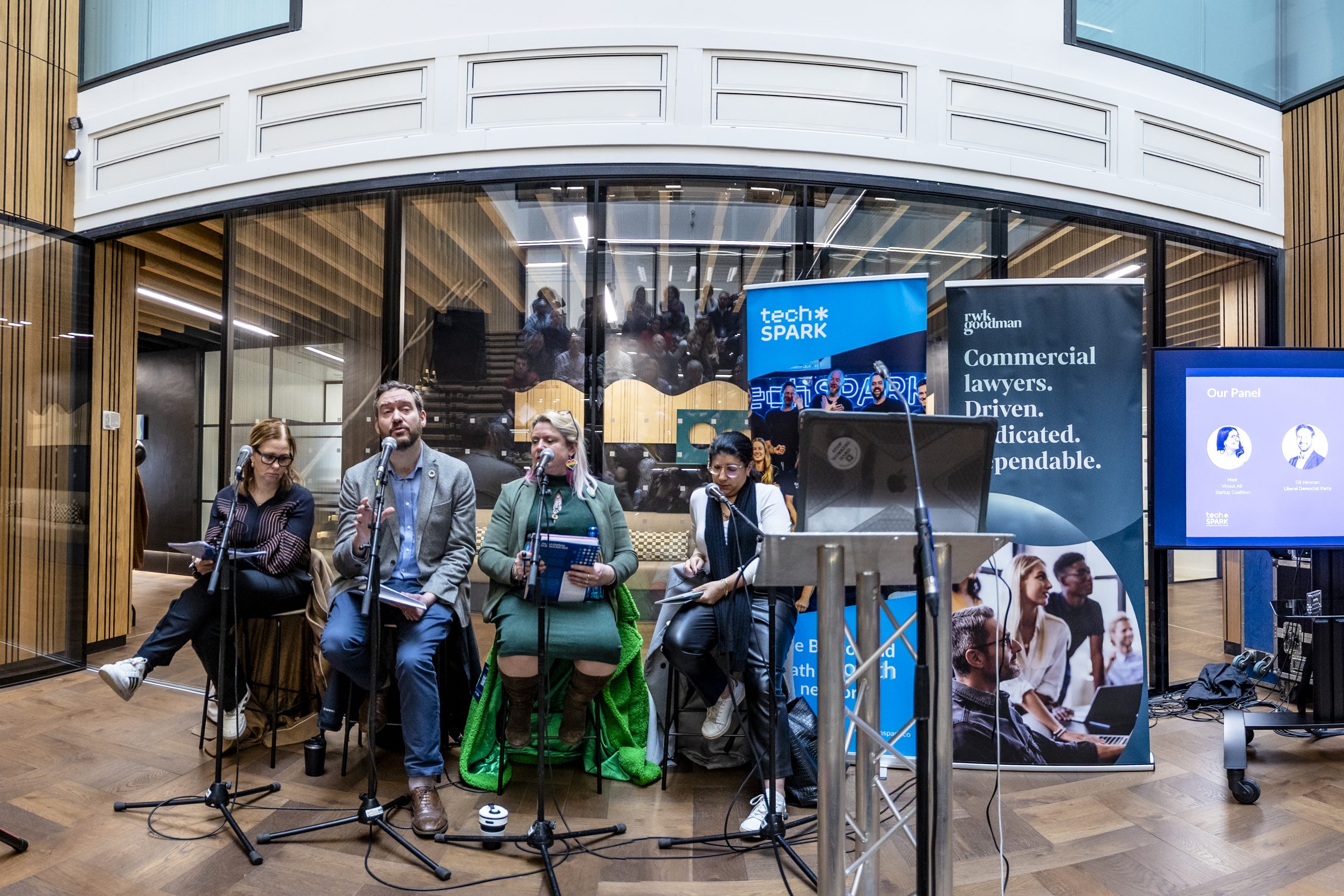
Earlier this week, techSPARK hosted the West of England Mayoral Hustings event at the EQ offices in Bristol, marking the start of UK Tech Week. The event provided a platform for members of the tech community to engage with prospective mayoral candidates ahead of the upcoming election on the 1st of May 2025. With innovation and digital growth central to the region’s economy, attendees had the opportunity to hear firsthand about each candidate’s plans for the future of the industry.
The Hustings was chaired by Vinous Ali from Startup Coalition, who led a discussion with the candidates on three key topics: investment, housing and skills development. Attendees heard from Helen Godwin (Labour Party), Mary Page (Green Party) and Oli Henman (Liberal Democrats), while Steve Smith (Conservative Party) was unable to attend due to magisterial responsibilities but provided a video message for the audience.
techSPARK CEO Ben Shorrock opened the event by presenting the techSPARK manifesto. The document outlined eight key asks from the tech community to the new West of England Mayor for them to focus on once they are elected. The asks ranged from prioritising investment in digital infrastructure to securing affordable workspaces in the region. You can view the full manifesto here.

Growing & Investing In The Region
The discussion opened with Vinous asking each of the candidates how they would attract venture capital and investment to the region.
Helen initially talked about a need for strong leadership to attract investment and advised that the next mayor must actively promote the region to potential investors. She used Liverpool Mayor Steve Rotheram as an example, who secured 1,000 AI jobs by meeting with Kyndryl executives in New York as part of a trade mission. Helen suggested a similar approach could help businesses stay and grow in the South West rather than relocating to other parts of the UK.
Oli proposed using public funds as leverage to attract outside investment and suggested creating an infrastructure development fund and prize incentives to drive innovation. He also emphasised the importance of collaboration between businesses, universities and local government to create a more attractive landscape for external investors.
Mary suggested focusing on sustainable investment and proposed working with green investment funds to ensure funding reached businesses that are already established in the area. She also stressed the need to align investment with environmental goals to ensure local communities received the benefits of economic growth while supporting the transition to a greener economy.
Supporting & Connecting The Community
After discussing investment, the panel moved on to housing, transport and the role they both play in the region’s growth and quality of life.
Housing
On housing, Helen emphasised the importance of linking new housing developments with transport infrastructure to create well-connected communities. She highlighted the need for a coordinated regional strategy to prevent future generations from being priced out and added that new developments should be part of sustainable communities.
Oli suggested implementing a spatial strategy for future housing that balances development with green spaces. He called for regenerative planning that not only provides housing for regional communities but also improves biodiversity.
Mary said she would focus on creating affordable, energy-efficient homes and advocated for sustainable urban planning that benefits local communities. She also suggested integrating housing plans with local skills development to ensure that new construction projects create jobs and training opportunities for South West residents.
Transport
To improve transport, Helen and Oli both suggested that franchising the bus network in the South West would be the best way forward. They said they would push for greater control over routes and fares, which, in turn, could improve the quality and accessibility of transport in the region.
Helen called for an overhaul of the public transport system and stated that the current network limited job opportunities and meant local residents relied on less sustainable transport options.
Oli highlighted the importance of rural connectivity and stressed the need for isolated communities to have access to reliable public transport options. He also advocated for integrating public transport with housing and employment hubs to create a more connected and accessible system.
On the other hand, Mary proposed implementing an integrated ticketing system that would allow people to travel seamlessly across the region using all modes of public transport. She also suggested using smart technology to map travel demands in the community and explore alternative transport solutions.
All of the candidates agreed that Bristol’s lack of a mass transit system was a major challenge, and they offered potential solutions such as a metro or cable car network to improve regional transport options.

Developing Current & Future Skills
Vinous’ final question for the panel was about how they would improve skills & education within the workforce to ensure it was well-equipped for emerging industries such as green tech. All of the candidates started by highlighting the importance of businesses and local authorities coming together to support education and training across the region.
Mary pointed out that the adult skills budget was limited and that most of the funding tended to support individuals with degree-level qualifications. She argued that more resources should be directed towards upskilling and vocational training for those without formal qualifications, helping to create a more inclusive workforce. Mary also suggested that local businesses could play a greater role in providing training opportunities and supporting individuals looking to enter growing sectors such as green tech.
Helen proposed training teachers in digital skills to improve the quality of computer science education in schools. She recognised that many students risked being left behind due to a lack of specialist teaching in subjects like coding and AI.
Helen went on to emphasise the need to create clearer career pathways by forming partnerships with local schools and colleges. She suggested linking the pathways with high-growth industries would better prepare students for future job opportunities.
Oli agreed that education should be better aligned with the needs of local businesses and suggested expanding apprenticeships and industry-focused training programmes. He highlighted the role of universities and employers in developing practical skills programmes that would equip people with the experience needed for high-tech and creative industries.
All of the candidates agreed that skills development must be a priority to keep the West of England competitive in an evolving job market. They also shared the view that lifelong learning opportunities should be expanded to make it easier for people to retrain and adapt as new technologies emerged.

Questions From The Community
Vinous then opened the discussion up to the attendees and allowed them to ask their own questions to the three candidates. The first question from the audience focused on the benefits and challenges of AI for the region and its workforce.
AI: The Benefits & Challenges
The first question from the audience focused on the benefits and challenges of AI for the region and its workforce.
Helen started by emphasising the need to educate the public on the advantages of AI and how it could improve public services such as healthcare and transport. She suggested that clear communication and transparency were necessary to address any concerns about AI’s role in the workplace.
Oli highlighted how AI could be used to support climate adaptation, transport modelling and energy efficiency. He suggested that data-driven insights could help make the region’s infrastructure more sustainable. Oli finished by saying that AI could potentially be used to predict traffic patterns and reduce congestion around the region, helping to improve public transport services.
Mary suggested that a more cautious approach to AI was needed and advocated for responsible AI development to avoid potential ethical risks. She also called for AI governance and regulation to ensure that technology was developed in a way that benefited society rather than furthering existing inequalities.
Creative Industries & Cultural Investment
The audience discussion moved towards how each of the candidates would invest government funding in the creative industries if they were elected.
Helen & Oli suggested building on Bristol and Bath as creative hubs by increasing investment in film, TV and digital industries. Helen pointed to the success of Channel 4’s relocation to Bristol and mentioned that investing in similar initiatives could help attract more talent and business to the South West.
Oli said he would focus investment on both large-scale productions and grassroots creative projects to ensure the region retained its strong creative heritage. He also stressed the need for long-term investment in creative infrastructure to make sure the region has the studios, venues and workspaces to support current and existing talent.
Mary suggested that new funding should be used to help creatives adapt to new technologies and support independent artists, musicians and community-led projects rather than just focusing on commercial viability.
Regional Visibility & Global Investment
The audience’s questions finished with a discussion on how to raise the West of England’s national and international profile. All of the candidates agreed that we needed to strengthen the representation of the South West on the global stage to attract new business, secure funding and keep the region competitive in key industries.
Helen started by highlighting the importance of proactive leadership in securing future investment. She repeated her use of Channel 4’s relocation to Bristol as an example of how advocacy can attract major organisations to the region. She went on to say that the new mayor must actively promote the region to national and international investors to ensure it can compete with other UK innovation hubs.
Oli highlighted the need to strengthen ties with global investors and position the West of England as a leading destination for high-tech industries. He suggested that trade deals, investment partnerships and international collaborations would help boost the region’s economic profile.
Mary said she would focus on collaborative business-government efforts to drive visibility of the region. She went on to say that the visibility should drive inclusive and sustainable growth – particularly in green technology and ethical AI. She also suggested that playing a key role in climate action and digital transformation would help to boost visibility and proposed forming partnerships with other European cities and international research institutions to achieve this.
All of the candidates agreed that raising the region’s profile required a combination of strong leadership, strategic marketing and cross-sector collaboration.

Closing Remarks
As The Hustings finished up, each candidate reiterated their vision for the future of the West of England. Helen promised to be a proactive mayor and emphasised the need for strong leadership to secure investment, improve public transport and ensure all communities can benefit from economic growth.
Oli focused on the power of collaboration and highlighted the importance of working with businesses, universities and local authorities to drive sustainable growth. He reiterated his commitment to improving transport connectivity, supporting innovation and making the region a national leader.
Mary re-confirmed her vision for the region and advised a focus on inclusivity in the future. She advised that any investment into the South West should prioritise people and the planet. Mary finished by pushing the need for affordable, energy-efficient housing, better public transport and ethical AI development.
Each candidate presented their own approach, but they all agreed that bold action is needed to secure the region’s future. Whoever the next mayor for the West of England is, they all appear to want to make it a thriving, well-connected and globally competitive place to live and work.
Thank you to our partners RWK Goodman for sponsoring our Hustings event.
The election will be held on Thursday 1 May 2025. The deadline to register to vote for this election is midnight Friday 11 April 2025. More information is available here.


