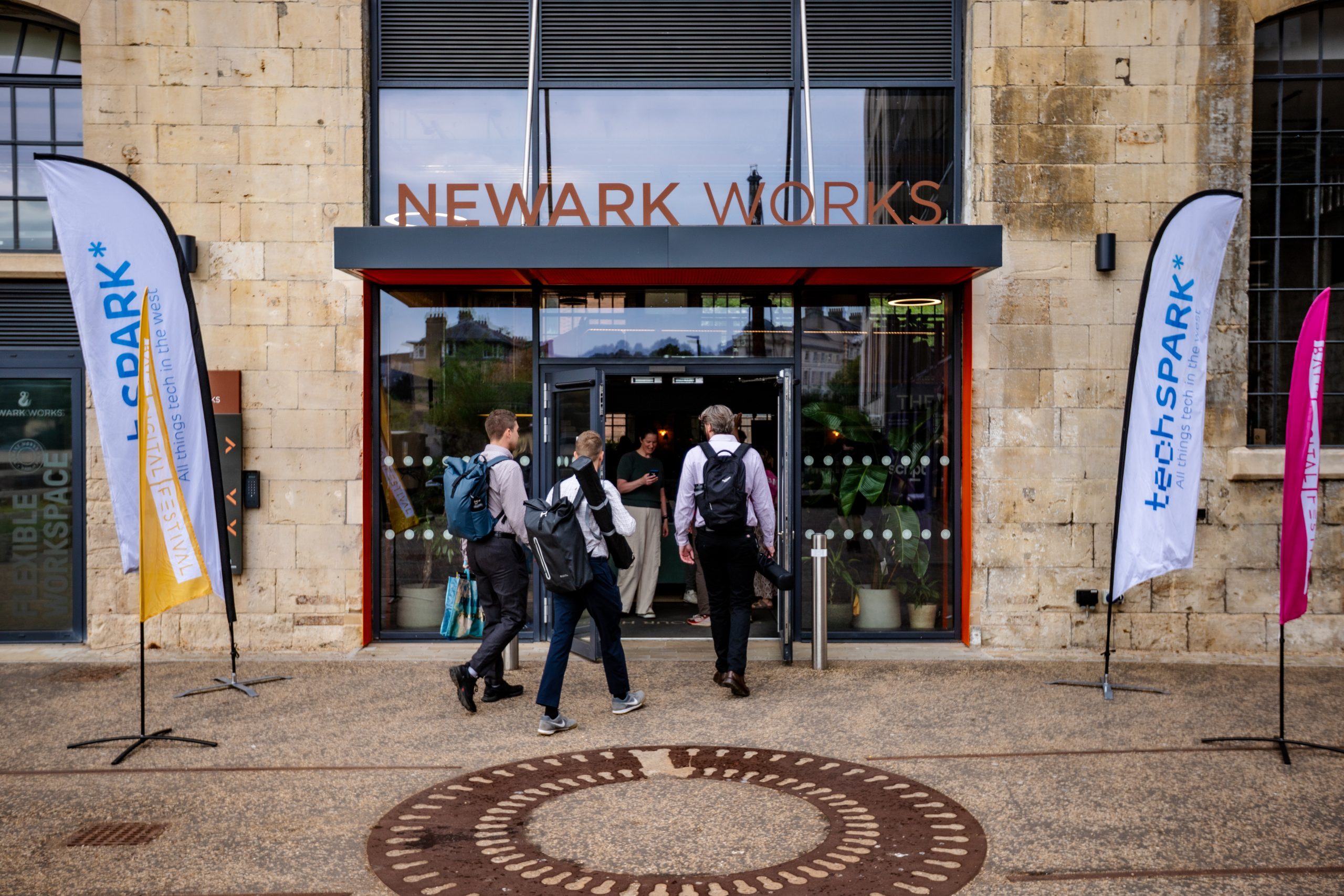
A public debate at Bath Digital Festival with Rebecca Huffee and David Kelly, moderated by Judith Coghlan, Partner at Script IP.
With national budgets tightening and public services under pressure, is large-scale investment in space still justifiable? That was the central question at one of Bath Digital Festival’s most thought-provoking sessions — a public debate titled Stardust and Spending Priorities, moderated by Judith Coghlan.
The session brought together Rebecca Huffee, Cluster Manager at Space West, and David Kelly, CEO of Storm Consultancy, to explore the balance between long-term strategic investment and immediate social need. The audience was invited not only to listen but to engage — making this more than a theoretical exchange.
The Case for Space as Infrastructure
Rebecca Huffee opened the discussion by reframing space not as exploration, but as infrastructure. “This isn’t about rockets and astronauts,” she explained, “it’s about services we rely on every day.” Satellite infrastructure underpins much of the UK’s digital economy — from navigation systems that enable financial transactions, to Earth observation tools used in agriculture, disaster response, and climate modelling.
According to government estimates, the space sector contributes £18.9 billion to the UK economy and supports over 50,000 jobs. But Huffee focused less on numbers and more on systemic dependence: “If we lost access to Positioning, Navigation and Timing services tomorrow, the UK economy could lose up to a billion pounds per day.”
She also pointed to space’s role in sectors like ethical investment (verifying sustainability claims through Earth observation), global diplomacy (e.g. continued ISS cooperation with Russia despite geopolitical tension), and climate resilience (supporting companies like Map Impact and Fathom, which use satellite data for wildfire and flood risk modelling). For Huffee, space enables not only future innovation but present-day security and stability.

The Question of Timing and Trade-Offs
David Kelly acknowledged the value of space technology but challenged the prioritisation of public funding under current economic conditions. “The issue isn’t whether space matters. The issue is whether now is the right time for this level of investment — when healthcare, social care, and homelessness are at crisis levels.”
Drawing on data from the UK’s National Audit Office and the Financial Times, he noted that government investment in the European Space Agency (ESA) yields approximately £0.93 per £1. He went on to say that this benchmarked below the national average return on government investment (£9.30). Judith then pointed out that this figure was significantly lower than sectors like education, which see returns of around £13.
“These are opportunity costs,” David continued. “If we have finite funds, we must ask where the biggest returns — economically and socially — can be made right now.”
He also raised concerns about where talent is directed. Many of the skills employed in the space sector — in data science, imaging, and systems engineering — are urgently needed in sectors like the NHS, cybersecurity, and renewable energy. “It’s not just about money — it’s also about where our people can make the most immediate difference.”

Public Perception, Strategic Sovereignty, and Global Influence
The session explored how public perception influences investment decisions. Kelly highlighted that space is often seen through the lens of billionaire ventures or high-profile exploration projects, rather than as part of national infrastructure. Huffee agreed this perception is limiting and pointed out the UK’s growing capabilities in commercial space — from Space Forge’s orbital manufacturing to companies exploring the development of pharmaceuticals in microgravity.
Both speakers addressed the issue of strategic sovereignty. Huffee emphasised that satellite capabilities are not only economic tools but also geopolitical assets — influencing everything from communications to military intelligence. “Space isn’t a luxury. It’s part of how modern nations operate,” she said.
Inefficiencies and Fragmentation
Several points were raised around how investment decisions are made. Huffee criticised fragmented funding strategies in the UK, where space, AI, quantum, and semiconductor development are treated separately despite being highly interdependent. “We need systems thinking — not vertical budgets,” she said.
Kelly questioned whether private investment should bear more of the risk. With venture capital increasingly active in space, is public funding still playing a catalytic role, or is it subsidising speculative ventures with unclear near-term benefit?
Huffee noted that in the UK, investor risk appetite is still relatively conservative, particularly compared to the US. Government support remains crucial for early-stage technologies and companies that need help to reach demonstration and deployment.
A Complex, Interconnected Future
Throughout the session, Judith Coghlan ensured the debate remained grounded, resisting any binary conclusions. This wasn’t a contest between science and social services. It was a deep dive into how we define national value — and how we weigh speculative returns against immediate need.
For Huffee, the future economy — from manufacturing to climate resilience — cannot be separated from space. For Kelly, the call is for precision: to ensure that investment follows impact, not aspiration alone.
What the discussion ultimately revealed is that space investment is not just a question of scientific ambition or commercial potential. It’s a question of economic strategy, national capability, and societal priorities. As one audience member put it, “This isn’t about whether space matters. It’s about how we decide what matters most right now.”
Key Takeaways for Those Who Missed the Debate:
- Space is infrastructure: From GPS to banking, much of our critical infrastructure relies on satellite systems.
- Investment returns vary: While space enables long-term value, short-term return on public investment may lag behind sectors like education or manufacturing.
- Strategic influence is at stake: Satellite capability confers geopolitical power, including in diplomacy and defence.
- Public perception matters: The narrative around space needs to shift from spectacle to service.
- Better integration is needed: Cross-sector strategies (e.g. quantum, AI, space) should be coordinated to maximise public value.
- The real debate is not “space or services”: It’s about when, how, and where investment can deliver the greatest impact.
Thank you to our sponsors Invest Bristol and Bath for supporting our events on Space Day.