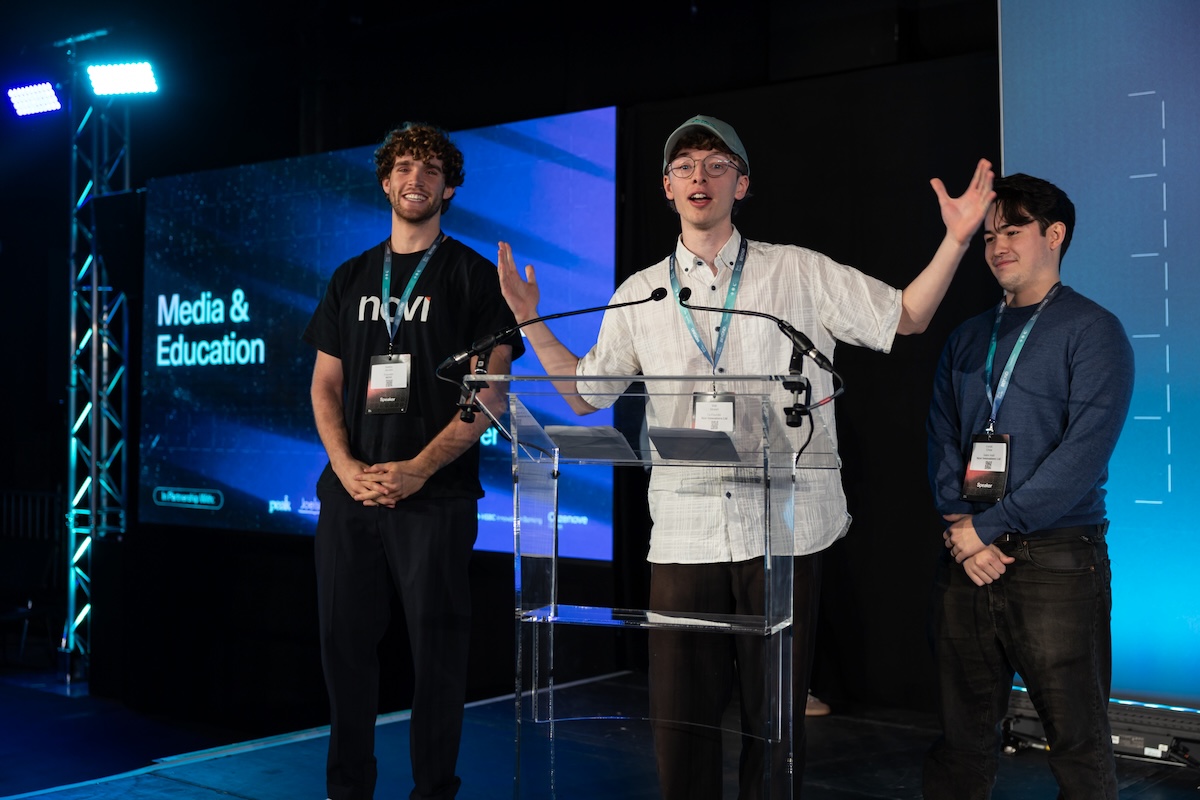
Thank you to Michael Calver, CEO & Founder at Amutri for providing this guest blog as part of createch month.
For us, Createch is not a category. It is a shift in how teams work.
It is what happens when creativity and technology stop sitting in different rooms and start solving problems together. It is not about art meeting code. It is about ideas becoming real through collaboration, iteration and speed.
Createch is often presented as a collision of industries, but we see it more as a fusion of mindsets. The most interesting teams today are not simply building new tools or designing new experiences. They are rewriting how problems get solved. Not by doing more, but by working more clearly, visually and together.
This is the space Amutri lives in.
We sit at the intersection of creativity, technology and pioneering built environment projects. Our platform helps organisations turn engineering complexity into visual clarity, so people can align faster, understand more quickly, and act with confidence. We see this not as a niche application, but as a shift in how complex teams across sectors are starting to communicate and collaborate.
From File to Frame: Why 3D Visualisation is Becoming the First Step
In the past, 3D Visualisation came at the end. A polished output after weeks of effort. A final flourish once decisions were made.
Now, that sequence is reversing.
3D Visualisation is starting to become the first step, not just the final output. While it is not yet the norm, we are seeing forward-thinking teams open ideas with 3D rather than close them with it. Engineers are using visuals to explore options, not just document outcomes. Stakeholders are engaging earlier, testing ideas rather than simply approving them. 3D Visualisation is shifting from a deliverable to a conversation.
At Amutri, we are helping make that shift easier. Our 3D Visualisation platform transforms Computer aided design (CAD) data into interactive, browser-based 3D presentations in just seconds. No specialist hardware, no steep learning curves. Just clarity, instantly.
The result is faster alignment, clearer communication and fewer delays. And that matters. Because in sectors like infrastructure, energy and engineering, progress often hinges not on ideas, but on how quickly and effectively those ideas are shared.
Createch Outside the Capital
One of the most exciting things about Createch is where it is happening.
Unlike other parts of the UK’s tech economy, Createch is not confined to London. A 2021 Tech Nation report found that 50 percent of Createch companies receiving VC investment were based outside the capital. This decentralisation is powering a new kind of growth, and one that is more regional, more diverse, and more deeply connected to the industries it serves.
That resonates with us. Based in Cornwall in the South West, Amutri is proud to be part of a creative tech ecosystem that is expanding beyond old boundaries. We believe innovation should not be gated by geography, and we are encouraged to see a national momentum building across Createch.
Why Visual Communication Is Now Operational Infrastructure
In many teams, complexity still clogs communication. Engineers produce visuals that never leave their department. Stakeholders sign off on PDFs they cannot fully interpret. Project momentum is lost to feedback loops and alignment gaps.
This is not a failure of effort. It is a failure of tooling and assumptions.
Createch offers an alternative: a model where creativity and technology combine to create understanding, not just output. A model where the right format, shown at the right time, can save weeks of miscommunication.
We believe visual communication is no longer a ‘nice to have.’ It is operational infrastructure. It connects decision-makers with delivery teams. It bridges departments and disciplines. And it turns technical proposals into shared vision.
Momentum Through Shared Context
McKinsey has identified shared digital spaces as a critical enabler of faster cross-functional decision making. Our work echoes this. When teams can see the same thing, in real time, in a format they understand, something powerful happens.
Conversation becomes action.
Feedback becomes iteration.
Delay becomes momentum.
Amutri supports this by enabling fast-turnaround 3D content that fits into live workflows. Teams no longer need to send static documents, schedule walkthroughs days in advance, or wait on renders to align. They can open a presentation, explore together, and make a decision. That shift from presentation to participation is where the real value lies.
Createch as a Workstyle, Not a Sector
At its core, Createch is not just a convergence of industries. It is a rethinking of how we work.
It asks new questions. Can design and delivery collaborate in real time? Can technical content be as accessible as marketing content? Can visuals stop being handoffs and start being habitats for decisions?
These questions are not theoretical. They are practical. And they are becoming central to how leading organisations operate.
We believe the future of Createch belongs to teams that simplify how they communicate, and who see clarity as a competitive advantage.
What You Can Try Next
If this resonates, here are a few ideas to explore in your own team:
Look for where things got stuck. Think back to a recent project. Where did communication stall? Could a clear visual early on have changed the outcome?
Switch up your next review. Instead of kicking off with slides, open a live model or interactive 3D view. See how it changes the energy in the room.
Share outside your bubble. Show a visual to someone who isn’t deep in the details. If they can follow it, great. If not, that might be a signal to rethink how you’re communicating.
Take stock of your tools. Are they helping people understand and move faster, or just adding steps before action can happen?
Final Thought
Createch is not about replacing creativity with code, or layering software onto art. It is about making great ideas easier to understand, shape and share. It is about using technology to unlock progress through clarity.
At Amutri, we are proud to support the organisations leading this shift.
If you are exploring how to align teams faster, solve problems more visually, or reduce friction between ideas and execution, we are always open to a conversation.
Let’s turn complex ideas into shared understanding. If your team is tackling big ideas and needs faster alignment, clearer communication, or a better way to bring people on board, now is the time to see what 3D Visualisation can unlock.
See how instant 3D Visualisation is changing the way teams think and work at https://www.amutri.com/